
Knog Bandicoot Run 250
$54.99 at Amazon
Check it on AmazonPrice as of Oct 22, 2026, 3:13 AM EDT
Why it’s our pickFour headlamps that stay put and last the run.

As an Amazon Associate I earn from qualifying purchases.
Get the Knog Bandicoot Run 250 for most runners: 60 g, a waterproof IP67 body, a strap that glows red at the sides, and 8 hours at full power. For the lightest headlamp, the 47 g Nitecore NU25 UL. For rain and snow, the Black Diamond Spot 400-R. To be seen from behind, the BioLite Dash 450 with its rear red light.

Product prices and availability are accurate as of the date/time indicated and are subject to change. Any price and availability information displayed on Amazon.com at the time of purchase will apply to the purchase of this product.
Our spec score uses six checks from the makers’ own spec sheets, weighted the same for every headlamp. All four clear our 7.0 floor. The method is at the bottom of the page.
Prices and availability are accurate as of the time shown and may change.
You run roads or paths for an hour or more and want a light that stays on the whole time.
You run technical trails and want a long beam. The Nitecore reaches 132 m.
Knog’s Bandicoot Run 250 is the running headlamp we’d start most people with. It scored 8.5, the top score here, because it does the three things a runner needs at once: it’s light at 60 g, it’s fully waterproof, and it lasts 8 hours at its brightest setting. The next best, the Black Diamond, lasts half as long at full power.
The catch is that full power is 250 lumens, the lowest top setting of the four. Knog lists a beam of up to 130 feet, about 40 m. That suits lit streets, paths and gravel roads. For a dark, rocky trail, a longer beam like the Nitecore’s 132 m shows more of what’s coming.
Knog splits the light into modes, each with four brightness levels. Combo runs up to 250 lumens for 8 to 28 hours, spot up to 200 lumens for 12 to 36 hours, and a wide ambient beam up to 50 lumens for 22 to 70 hours. There’s also a red light and a small reading light, and Knog says the output is regulated.
The visibility trick is the strap. Side LEDs light up the translucent silicone band, which Knog calls a red halo, and it says this improves visibility all the way around. It isn’t a separate rear light like the BioLite’s, but it does glow at the sides of your head, where most headlamps are dark.
The strap is one piece of medical-grade silicone that Knog says is easy to clean and resists odour, and it fits heads from 11.8 to 26 inches around. The pod is rated IP67, so it’s fine in rain and survives a dunk to 3 feet.
Charging is the trade-off. There’s no cable: the pod plugs straight into a USB-A port and fills in 4 hours. That means no lost cable, but you can’t charge it from a USB-C-only phone charger without an adapter. Knog backs it with a 2-year warranty, and on Amazon it’s sold by Knog itself.
Prices and availability are accurate as of the time shown and may change.
You count grams, run dark trails, and can run at mid power for most of the outing.
You want 3 or more hours at full power. The Knog lasts 8.
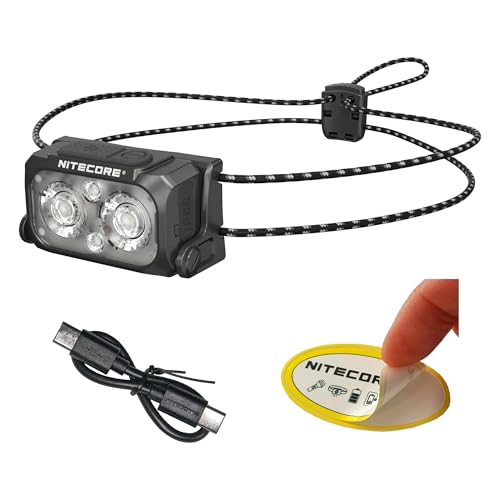
The Nitecore NU25 MCT UL is the pick if weight is what bothers you about headlamps. Nitecore lists it at 47 g with the bracket and headband, the lightest of our four. It scored 8.1. The UL in the name is Nitecore’s ultralight version, which swaps a wide band for a thin elastic cord.
It also throws the longest beam here. Nitecore rates it at 400 lumens and 132 m at full power, about three times the Knog’s reach. For a trail where you need to see roots and rocks well ahead, that’s the headlamp in this group that shows the most.
Full power doesn’t last long. Nitecore’s own output table lists 2 hours 40 minutes at 400 lumens, the shortest of the four. Drop to its 200 lumen mid setting and it runs 5 hours; at 60 lumens it runs 13. Most runners will want to plan on mid power for anything longer than a couple of hours.
The color choice is unusual. Nitecore gives three white color temperatures: warm at 3,000K, neutral at 4,500K and cool at 6,500K. Its Amazon listing says warm light is easy on the eyes and cuts through fog and rain, while cool white sharpens contrast.
Its red light is on the front of the lamp, so it helps you see up close, not drivers see you from behind. Nitecore rates the body IP66 against dust and water and impact resistant to 1 m, and the 700 mAh battery charges by USB-C. The seller’s listing says a charge takes just over an hour.
On Amazon it’s sold by Lumen Tactical rather than Nitecore itself. Nitecore’s manual covers a free swap for a dead-on-arrival unit within 15 days and free repair for 24 months. That’s why it scores a little below the Knog on warranty.
Prices and availability are accurate as of the time shown and may change.
You run in steady rain or snow and want the longest runtime at 400 lumens.
You want the lightest feel. The Nitecore is 39 g lighter.
Black Diamond’s Spot 400-R is the pick for wet weather. It scored 8.1. Black Diamond rates it IP67 and says it’s tested to work at least 1 m underwater for 30 minutes, so a downpour or a snowy run is well inside what it’s built for.
It also holds full power the longest of the 400 lumen lights. Black Diamond lists 4 hours at 400 lumens, 8 hours at 200 lumens and 225 hours at its 6 lumen low setting. The beam reaches 100 m on high and 60 m on medium, which covers most trails at a running pace.
Two controls matter on the move. PowerTap lets you switch straight between full and dimmed output, and Brightness Memory turns the light back on at the level you left it. The red night vision mode dims and strobes and comes on without cycling through white first.
An integrated meter shows the percent of battery left, which helps on a long run when you’re deciding whether to drop to medium. A digital lock stops it from switching on in a pack or a pocket. Separate proximity and distance modes let you pick a close-range light or a longer beam for the trail ahead.
The trade-offs are weight and the charging port. At 86 g it’s the heaviest of our four, and the 1,500 mAh battery charges by micro-USB, not USB-C. If every cable you own is USB-C, plan on keeping one micro-USB cable with it. There’s no rear light either, so pair it with a reflective vest on roads.
Black Diamond says all of its lighting carries a three-year warranty, the longest of our four picks. The headband is made with Repreve recycled fiber. On Amazon it’s sold by Black Diamond Equipment itself.
Prices and availability are accurate as of the time shown and may change.
You run on roads before dawn or after dark and want drivers behind you to see you.
You run in heavy rain or cross streams. The Black Diamond is rated IP67.
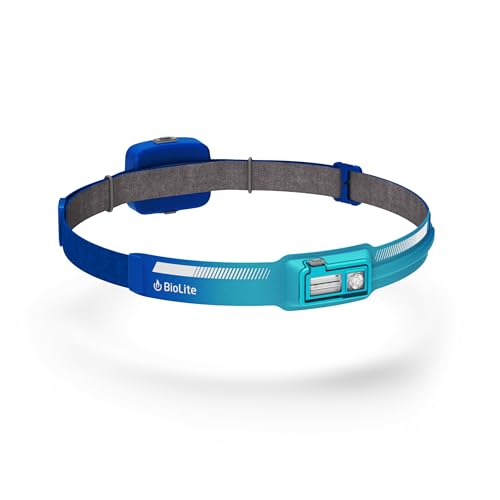
BioLite’s Dash 450 is the pick for being seen. It scored 8.0. It’s the only one of our four with a real rear red light, which you can set to a steady glow or a strobe, plus reflective printing on the band. BioLite says the two together give visibility from all directions.
BioLite also built the fit around running. The 1,000 mAh battery sits at the back of your head next to that rear light, and the front is only 10 mm thick. BioLite says keeping the weight and bulk off your forehead is how it stops the bounce. The band lining is a moisture-wicking fabric.
It’s the brightest pick at 450 lumens. A spot lens gives up to 325 lumens and a 90 m beam, and a flood lens gives up to 125 lumens and a 15 m spread for your feet. You can run them together. The front bezel tilts so you can aim the beam down the road or at the ground just ahead.
Runtime is 3 hours on high and 60 hours on low, with a 1-hour reserve at 5 lumens when the battery is nearly empty. BioLite says it charges by USB-C in 2 hours, and you can run it from a power bank in your vest with a cable for a very long run.
Weather is the weak spot. It’s rated IPX4, which BioLite calls storm safe: rain is fine, but it isn’t made for going under water. At 78 g it’s the second heaviest here, though BioLite’s point is that the weight sits at the back.
BioLite’s product page lists a 1-year limited warranty plus a 30-day HolyFit Guarantee, which lets you return it if the fit doesn’t work for you. The Amazon text says 3 years; we go by the maker’s page. On Amazon it’s sold by BioLite itself.
Every spec comes from the maker’s own spec sheet. Scroll sideways on a phone.
| Pick | Photo | Score | Weight | Max light | Beam | Full power | Rating | Be seen | Buy |
|---|---|---|---|---|---|---|---|---|---|
| Knog Bandicoot Run Long runs | | 8.5 | 60 g | 250 lm | 40 m | 8 h | IP67 | Red strap glow | Check it on Amazon |
| Nitecore NU25 UL Lightest | | 8.1 | 47 g | 400 lm | 132 m | 2 h 40 min | IP66 | Front red only | Check it on Amazon |
| Black Diamond Spot Rain and snow | | 8.1 | 86 g | 400 lm | 100 m | 4 h | IP67 | Front red only | Check it on Amazon |
| BioLite Dash 450 Seen from behind | | 8.0 | 78 g | 450 lm | 90 m | 3 h | IPX4 | Rear red light | Check it on Amazon |
Pick how long you’ll be out and how bright you’ll run. We check it against each maker’s own runtime table.
Choose your longest run and how bright you’ll keep the light.
| Headlamp | Full power | About 200 lumens | Low setting |
|---|---|---|---|
| Knog Bandicoot Run | 250 lm: 8 h | 200 lm spot: 12 h | 50 lm ambient: 22 h |
| Nitecore NU25 UL | 400 lm: 2 h 40 min | 200 lm: 5 h | 60 lm: 13 h |
| Black Diamond Spot | 400 lm: 4 h | 200 lm: 8 h | 6 lm: 225 h |
| BioLite Dash 450 | 450 lm: 3 h | Not published | Low: 60 h (lumens not stated) |
From each maker’s spec sheet or manual, read Oct 22, 2026. Knog lists a range for each mode; the figure here is each mode’s top brightness. Nitecore’s 6 lumen setting runs 45 hours. BioLite adds a 1-hour reserve at 5 lumens.
Nitecore’s manual says its runtimes follow the ANSI FL1 standard, which times a light from full charge until it drops to a tenth of its starting output. So a headlamp can still glow after its listed runtime: it has dimmed, not died. Plan your run on the listed number, not the last flicker.
Weight is our biggest check, at 25% of the score. Every figure includes the battery and band.
The spread is 39 g, a little more than an ounce, and all of it rides on your head for every stride. Where the weight sits matters too. BioLite puts its battery at the back of the head, next to the rear light. Our running belt guide covers belts for your phone and keys.
Lumens say how much light comes out. Beam distance says how far it reaches.
| Headlamp | Max lumens | Beam at max | Wide beam for your feet |
|---|---|---|---|
| BioLite Dash 450 | 450 | 90 m (spot) | Flood up to 125 lm, 15 m |
| Nitecore NU25 UL | 400 | 132 m | One lens with several facets |
| Black Diamond Spot | 400 | 100 m | Proximity mode |
| Knog Bandicoot Run | 250 | 40 m | Ambient mode up to 50 lm |
Streetlights do most of the work, so a mid setting saves battery. The runtime table shows how much longer each light lasts at about 200 lumens.
Look at beam distance. All four reach at least 40 m, and the Nitecore reaches 132 m.
Roots and rocks come up fast. A longer beam, like the Nitecore’s 132 m or Black Diamond’s 100 m, shows more.
Nitecore’s Amazon listing says warm light cuts through fog and rain. The NU25 lets you pick warm, neutral or cool white.
More lumens isn’t always better on a run. Full power drains the battery fastest, and the runtime table above shows how much longer each light lasts at about 200 lumens. Runtime at full power is 20% of our score, and brightness is 15%, because a light that’s bright for one hour can leave you in the dark on a long run.
The IP code tells you how much water a headlamp is built to take. The second digit is the water part.
| Rating | What the maker says | Our picks |
|---|---|---|
| IP67 | Survives being under water; Black Diamond tests to 1 m for 30 minutes, Knog to 3 feet | Knog, Black Diamond |
| IP66 | Dust tight and protected from powerful water jets | Nitecore |
| IPX4 | Splash resistant; BioLite calls it storm safe and says don’t swim with it | BioLite |
For running in rain, all four are fine. The difference shows when the light gets soaked for a long time, dropped in a puddle or creek, or rinsed off after a muddy trail. That’s where IP66 and IP67 earn their place, and why weather is 15% of the score.
A headlamp lights your path. On a road, drivers behind you need to see you too.
| Headlamp | Rear or side light | Reflective | Red light |
|---|---|---|---|
| BioLite Dash 450 | Rear red light, steady or strobe | Reflective band printing | Front red flood, rear red |
| Knog Bandicoot Run | Side LEDs light the strap red | Not listed | Front red light |
| Nitecore NU25 UL | None | Not listed | Front red, 15 lm or 5 lm |
| Black Diamond Spot | None | Not listed | Front red, dims and strobes |
If you run on roads in the dark, the BioLite’s rear light is the simplest answer. With any of the others, add something on your back. Our reflective vest for running guide covers lighted and reflective vests.
Bounce comes from weight sitting in front of your forehead and a band that stretches. Here’s what each maker does about it.
BioLite moves the battery behind your head.
Knog uses one piece of silicone.
Nitecore keeps the whole lamp to 47 g.
Adjust it before you start, over a cap if you wear one.
BioLite says its band fits over a running cap or beanie. Knog’s strap fits heads from 11.8 to 26 inches around. Whichever you choose, tighten the band at home and take it for a short jog with the light on before the first long run.
All four have built-in rechargeable batteries. The plug is where they differ.
| Headlamp | Battery | Port | Charge time | Battery gauge |
|---|---|---|---|---|
| Knog Bandicoot Run | Built in | USB-A plug on the pod | 4 h | Yes |
| Nitecore NU25 UL | 700 mAh | USB-C | Just over 1 h (seller listing) | Power indicator |
| Black Diamond Spot | 1,500 mAh | Micro-USB | Not listed | Percent shown |
| BioLite Dash 450 | 1,000 mAh | USB-C | 2 h | 4 LEDs |
Knog says the Bandicoot charges best at 68 to 72 °F and lists an operating range of −4 to 122 °F. If you run early, charge the night before and check the gauge as you head out.
| Your running | Look for | Our pick |
|---|---|---|
| An hour or two on lit roads | Light weight, waterproof, long runtime | Knog Bandicoot Run |
| Long runs, over 3 hours | Long runtime at your usual level | Knog Bandicoot Run |
| Dark, rocky trails | Long beam, low weight | Nitecore NU25 UL |
| Rain, snow, creek crossings | IP67 | Black Diamond Spot 400-R |
| Roads with traffic behind you | A rear red light | BioLite Dash 450 |
| Weight bothers you | Under 50 g | Nitecore NU25 UL |
| Only USB-C cables at home | USB-C port | Nitecore or BioLite |
Start with how long you run, then where. Use the runtime planner above to check your longest run at the brightness you’ll use. Then decide whether you need the longest beam, the best rain rating or a rear light. If you also carry water, our hydration pack guide covers packs for long runs.
Our top pick is the Knog Bandicoot Run 250: 60 g, IP67, a strap that glows red at the sides, and 8 hours at full power. The Nitecore NU25 UL is lighter, the Black Diamond Spot 400-R is better in the wet, and the BioLite Dash 450 has a rear light.
There’s no single number. On lit streets, a mid setting around 200 lumens saves battery. On dark trails, more light and a longer beam show more of what’s ahead. All four picks reach at least 250 lumens, and the runtime table shows how long each lasts at about 200.
Look for low weight and a band that grips. The Nitecore NU25 UL weighs 47 g, Knog uses a one-piece silicone strap, and BioLite puts the battery at the back so the front is only 10 mm thick.
A headlamp points wherever you turn your head, so the light follows your eyes. A chest or waist light stays aimed down the path in front of your body. This guide covers headlamps only.
Yes. All four picks are rated for rain. The Knog and Black Diamond are IP67, the Nitecore is IP66, and the BioLite is IPX4, which BioLite says is fine for rain but not for swimming.
At full power: Knog 8 hours, Black Diamond 4 hours, BioLite 3 hours and Nitecore 2 hours 40 minutes. At lower settings they all run much longer, from 5 to 225 hours depending on the light.
Of our picks, the Nitecore NU25 MCT UL at 47 g with its bracket and band. The Knog Bandicoot Run is 60 g, the BioLite Dash 450 is 78 g and the Black Diamond Spot 400-R is 86 g.
A front red light keeps your night vision for map reading or stops. A rear red light helps drivers behind you see you. Only the BioLite Dash 450 has a rear light; the Knog’s strap glows red at the sides.
Nitecore’s Amazon listing for the NU25 says warm light is easy on the eyes and cuts through fog and rain, while cool white enhances contrast. Try both if your light lets you switch.
All four picks are rechargeable, so you start each run with a full battery and a gauge. Check the plug: the Knog uses USB-A, the Black Diamond micro-USB, and the Nitecore and BioLite USB-C.
The 6 means dust tight and the 7 means it survives being under water. Black Diamond tests the Spot 400-R at 1 m for 30 minutes. IPX4 means splash resistant only.
You can. BioLite says the Dash 450 band adjusts to fit over a running cap or beanie. Tighten it before you start so it doesn’t slip once the hat gets damp.
Life in Good Form is owned and edited by Isaac Daniels. Every number on this page comes from the maker’s own spec sheet or manual, or from the Amazon listing text where we say so. We don’t run lab tests, so we never present a number as measured by us.
Prices and photos come from Amazon and show the time they were read.
Every headlamp gets the same six checks. Each is scored out of 10, and the overall score is the weighted average. A headlamp needs 7.0 or more to be a pick. It’s built from what the makers publish only. It isn’t a customer rating or a lab test.
| Check | Weight | How it’s scored |
|---|---|---|
| Weight | 25% | 50 g or less 10 · up to 65 g 9 · up to 80 g 8 · up to 95 g 7 · up to 110 g 5 · heavier 3 |
| Runtime at full power | 20% | Hours × 2.5, up to 10 (4 hours = 10) |
| Max brightness | 15% | Lumens ÷ 45, up to 10 (450 lumens = 10) |
| Weather rating | 15% | IP66 or IP67 10 · IPX4 6 |
| Be seen | 15% | Rear red light 10 · lit or reflective strap 8 · neither 5 |
| Warranty | 10% | Lifetime 10 · 3 years 8 · 2 years 7 · 1 year 6 |